

Top Bottle Unscrambler Machines for Fast and Reliable Packaging Lines
2026-11-25
Bottle unscramblers are rarely the first machine buyers think about, but they are often the first to create a bottleneck. Jams, misoriented containers, and inconsistent feeding can quietly cap your line speed long before filling or capping equipment becomes the issue. Choosing a top bottle unscrambler machine for fast and reliable packaging lines starts with understanding where these systems fail and what separates high-throughput designs from average ones. In the sections ahead, we break down the machines that keep containers oriented and moving, including solutions from Wanying Machinery built for operators who value uptime.
What a Bottle Unscrambler Should Fix Before Anything Else
Most people assume the biggest headache with a bottle unscrambler is speed or jam frequency, but that overlooks the real problem hiding in plain sight: the machine rarely gets the chance to fail on its own terms. Before you add another sensor or upgrade the hopper, watch how bottles enter the sorting bowl. If operators have to babysit the infeed conveyor, adjust rail gaps by hand, or deal with containers that arrive wet, dirty, or static-charged, the unscrambler will never perform consistently no matter how well its internal logic works.
The first thing any unscrambler should fix is the mismatch between what the line feeds it and what the mechanism actually expects. A bottle that tips over before the bowl, or two bottles that stick together from residual label adhesive, will create false faults that look like unscrambler errors but are really upstream failures. The fix isn't another alarm; it's a modest belt speed change, a simple air knife, or repositioning the discharge of the depalletizer so bottles don't slam sideways into the first turn. Until that handoff is stable, tuning the bowl is just moving noise around.
After that, reduce unnecessary physical contact. Many unscramblers use fixed guides and pockets sized to one bottle family, so switching from a lightweight round jar to a squat oval forces the line crew to loosen screws, swap rails, and relearn the sweet spot. A better starting point is to make the few adjustments that matter the most accessible — not buried behind guards or requiring a wrench someone lost last week. If a machine can't be changed over by one person in under ten minutes without tools, it isn't ready for real production, regardless of its rated bottles per minute.
Rotary and Inline Systems Compared Without the Sales Pitch
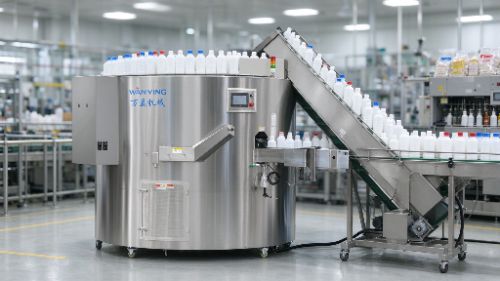
Rotary systems move parts through a circular sequence of stations, which keeps the machine footprint compact and often allows very high cycle rates because multiple operations happen at the same time. The trade-off is less flexibility: adding or rearranging stations usually means significant mechanical work, and access for cleaning or maintenance can be awkward once guarding and tooling are in place.
Inline systems arrange stations along a straight or slightly curved path. Changeover tends to be simpler since modules can be swapped or bypassed without disturbing the whole line, and operators generally have clearer access to each step. In return, the line takes up more floor space and may run at a lower peak rate unless parallel stations are added.
Neither arrangement is inherently better. Rotary often makes sense when the process is stable, space is tight, and output per minute matters most. Inline becomes more practical when product variants, inspection steps, or future revisions are likely, because the cost of change is lower over the life of the machine.
Why Real Throughput Rarely Matches the Brochure
Vendors love to quote the maximum theoretical data rate, but that number lives in a clean lab, not on your desk. Real throughput gets squeezed by overhead you can't see: packet headers, error correction, retransmissions, and the simple fact that Wi‑Fi is a shared, half‑duplex medium. Every device on the channel waits its turn, so more clients mean less airtime for yours.
Distance and interference do more damage than most spec sheets admit. A router rated for 2400 Mbps might deliver a third of that two rooms away, because the signal drops through walls, bounces off metal, or competes with a neighbor's network on the same channel. Older devices on the same network also drag the speed down—the access point slows to the pace of its slowest connected client more often than people expect.
Then there's the software layer. Background updates, cloud sync, and even your VPN tunnel eat into the pipe before a speed test ever runs. The gap between the brochure number and what you actually feel during a video call isn't a defect; it's the difference between a wind‑tunnel figure and rush‑hour traffic.
How Bottle Shape and Material Dictate Machine Choice
Bottle geometry does more than shape a shelf impression; it sets the mechanical rhythm of the line. A flared base or a sharply tapered neck can force a switch from standard worm feeds to servo-driven star wheels, because transfer points need controlled pitch instead of simple friction. Tall, narrow profiles with a high center of gravity often demand extra neck support or air-conveyor assists, while squat jars with recessed bottoms may require custom pocketed pucks just to stay upright through rinsing and filling.
Material stiffness changes the conversation again. Rigid glass and thick-wall PET tolerate aggressive clamping during capping and labeling, but they punish machines with hard stops. Lightweight or recycled-content bottles, especially flexible HDPE and thin-gauge PET, may collapse under vacuum or wander under pressure, so filling systems tilt toward volumetric or flow-meter nozzles with gentle product paths, and labelers move to wrap stations with soft brushes rather than rigid wipe-downs.
In practice, the bottle should drive the specification before speed or output gets locked in. Start with the container's shoulder slope, base stability, panel stiffness, and finish type, then choose infeed, filling, capping, and labeling modules that respect those limits. When shape and material lead, the line usually runs with fewer jam points and less need for constant operator correction.
Changeover Speed Is a Design Feature, Not an Afterthought
The time spent switching a production line from one product to the next is rarely treated with the same respect as cycle time or throughput. Yet in many facilities, changeover is where the real money leaks away. When equipment designers treat quick tooling swaps, accessible clamping points, and pre-set adjustment mechanisms as optional extras, operators are left improvising with wrenches and shims. That improvisation costs more than minutes; it costs consistency, because every manual workaround introduces variation that shows up later as scrap or rework.
A machine built for fast changeover does not simply have fewer bolts or faster actuators. It has a logic to the sequence: the parts that need to move are within reach, the connections that need to disconnect are visible and obvious, and the settings that need to change are captured on a dial or digital recipe rather than reset by feel. Designers who take this seriously often walk the line for an entire shift before sketching a single bracket, because the difference between a fifteen-minute changeover and a three-minute one is usually decided by how well the next person in line understands what the previous person left behind.
When changeover speed is engineered in from the start, it changes the economics of small batches. A factory that can switch tools without losing half a shift is a factory that can say yes to short runs, custom orders, and last-minute schedule changes without panicking. The machines become less precious, the operators less hesitant, and the whole operation less brittle. That flexibility does not come from a better procedure written after the fact; it comes from a frame, a fixture, and a control interface that refuse to make the next setup a puzzle.
Routine Upkeep That Protects Fast, Steady Bottle Flow
Most slow or sputtering flow starts with buildup you cannot see. After each use, pull the valve, seal, and spout apart and wash them in warm water with a mild detergent. A soft brush gets into the narrow slots where milk residue or drink mix tends to harden, and it does so without roughing up the silicone. Let every piece air-dry completely before reassembling; trapped moisture quickly turns gummy or leaves a stale smell that changes how the liquid moves through the opening.
The soft parts wear out long before the bottle or lid shows any damage. Give the silicone ring and valve a quick pinch whenever you wash them. If the material feels stiff, keeps a crease, or no longer springs back right away, replace it even if there is no visible tear. A tired seal may still look fine while letting air slip in unevenly, which leads to gulps, pauses, and mess around the rim. Keeping a couple of spare seals on hand makes this fix painless.
Mineral deposits from tap water or sterilizing cycles can narrow the flow path over time. Once a month, soak the removable parts in a mix of one part white vinegar to four parts water for about twenty minutes, then rinse thoroughly until the vinegar smell is gone. Store the bottle completely disassembled rather than locked shut; this lets air circulate and prevents the seal from taking a permanent compressed shape that interferes with a smooth, steady release.
FAQ
It takes bulk bottles dumped into a hopper and turns them into a single-file stream with every container upright and facing the same direction. That lets the rest of the line run at steady speed without manual sorting.
Rotary units use a spinning bowl or wheel to carry bottles through orientation points, which suits high-speed lines with consistent container shapes. Inline machines feed bottles along a straight conveyor and usually work better when you have frequent size changes or lower ceilings. The real trade-off is speed versus flexibility.
Most can handle round, square, oval, and tapered PET or HDPE bottles, as well as some jars and wide-mouth containers. The key is adjusting rails, pockets, and air jets to match the container profile, and some shapes may need custom change parts.
Look for tool-free adjustments, recipe storage, quick-release rails, height adjustable hoppers, and rapid-change sorting wheels. A well-designed control panel that saves profiles for each bottle type helps operators switch lines in minutes rather than hours.
If a bottle arrives leaning, reversed, or misaligned, downstream fillers, cappers, and labelers may jam or place closures and labels incorrectly. Accurate orientation prevents micro-stops and keeps reject rates low on fast lines.
Daily cleaning of hopper and sorting surfaces, checking air pressure and moisture traps, inspecting wear on belts, rollers, and change parts, and lubricating per the manual. Operators should also watch for dust buildup around sensors because dirty optics can cause false fault readings.
Many can, but not all. Machines with adjustable guide rails, servo-driven sorters, and stored recipes handle a broad range. For very small to very large container jumps, you may need separate change parts or a different machine platform.
A hopper with inclined cleats or a rotating elevator delivers bottles in predictable batches, while a simple open hopper can bridge or flood irregularly. Matching hopper capacity and discharge control to line speed helps avoid gaps and overfeeding.
Conclusion
A packaging line only moves as smoothly as its bottle feed, and most unscrambler problems have little to do with motor power or brand reputation. Before comparing rotary and inline units, it is worth fixing how bottles enter the machine, how they sit after orientation, and where jams tend to form. Bottle shape and material often force the decision more than any spec sheet: tall lightweight PET bottles behave differently from squat glass containers, and a machine that handles one may stumble on the other. The gap between published throughput and what actually reaches the filler usually comes down to those mismatches, not just optimistic marketing.
Changeover deserves the same attention as top speed because a fast line that takes an hour to switch formats creates more downtime than a slightly slower machine with tool-free adjustments. The best designs treat guides, rails, and sorting discs as parts that operators can reposition quickly without calling in a specialist. After that, steady output depends on routine upkeep: checking sensors, clearing worn grippers, and keeping the hopper level consistent. An unscrambler that is cleaned and inspected during short pauses will hold its rhythm far longer than one run hard until something breaks. Reliable packaging speed is rarely a single number, it is the result of matching the bottle, the changeover habits, and the maintenance routine to the machine.
Contact Us
Contact Person: Tyson
Email: [email protected]
Tel/WhatsApp: +8613396971296
Website: https://www.wanyingmachinery.com