

Spiral Freezer Supplier: Key Factors to Consider for Your Food Processing Facility
2026-09-12
If you're evaluating spiral freezer suppliers, the stakes go beyond equipment cost—food quality, floor space, and long-term service all hinge on this choice. Worldbase recommends looking past spec sheets to the factors that determine real performance in a processing facility. This guide breaks down what to prioritize.
Sizing the Freezer Around Your Coldest Production Days
Most operations pick a freezer size based on average daily production, then panic when a cold snap or a big order pushes volume up. That’s backward. Your freezer should be sized around the days that generate the most thermal load, not the days that just trickle in.
Pull three to six months of production logs and mark every day where you froze more than 80% of your record high. Those are the cold production days that actually matter. Look at the total mass, incoming temperature, and freezing time required for each product. Add up the peak-hour load, not just total daily volume, because a freezer can handle a big day if the load is spread out but will fail if everything hits at 4 p.m.
Once you have that number, add 15% for shifts in product mix or a sudden rush. Skip the temptation to double it “just in case.” An oversized freezer costs more to run every single day, even when it’s half empty. Modular units or a portable cold room rental can cover the rare extreme without locking you into wasted space year-round.
Why Defrost Cycles Can Quietly Drain Your Throughput
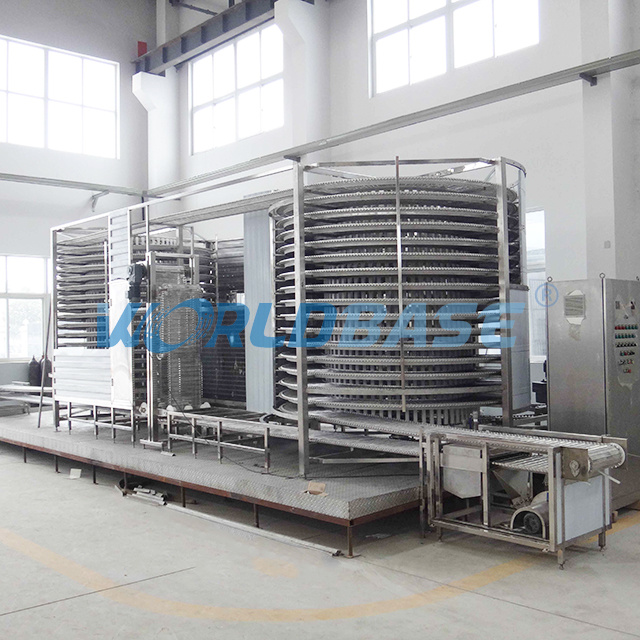
Most operators track obvious downtime like equipment failures or changeovers, but defrost cycles slip under the radar because they're scheduled, expected, and seemingly brief. A walk-in freezer might go into defrost four times a day for twenty minutes each, which feels negligible on paper. Yet during those cycles, the evaporator fans often stop, the coil warms, and any product within the blast zone experiences a subtle temperature swing. For continuous processes or high-turnover storage, that's not a pause—it's a recurring tax on your system's ability to hold steady conditions.
The real drain shows up in aggregate. If a defrost cycle interrupts airflow for even fifteen minutes while production is active, you're not losing just those fifteen minutes of cooling. You're losing the time it takes to pull the space back down to setpoint, which can double or triple the apparent downtime. In blast freezers or spiral chillers, where product is moving through on a tight rhythm, that recovery lag directly cuts into how many pallets or batches you can process per shift. Multiply that by three or four cycles a day, and the throughput loss becomes a silent, fixed overhead.
Smart facilities treat defrost as a design variable, not a routine nuisance. Shifting cycles to off-peak hours, using demand-based defrost that only triggers when frost actually builds up, or rethinking coil placement so warm air doesn't kiss the product can reclaim hours of effective run time each week. The goal isn't to eliminate defrost—it's to make sure it never quietly competes with your line speed.
Material Choices That Withstand Aggressive Washdowns
Stainless steel remains the go-to for most aggressive washdown environments, but the specific grade makes all the difference. Type 304 handles routine cleaning with mild detergents, yet once chlorinated sanitizers or high-pressure hot water enter the picture, 316L becomes non-negotiable—its molybdenum content resists pitting far better. For corners, brackets, and fasteners where crevice corrosion hides, opting for electropolished 316L further smooths microscopic peaks, denying bacteria and chemical residues a foothold.
Beyond metals, engineered polymers like PTFE and UHMW-PE earn their place in washdown zones. PTFE shrugs off nearly every cleaning agent, from caustic foams to acid rinses, while UHMW-PE adds impact toughness for guide rails and wear strips. But not all plastics survive: standard nylon absorbs water and swells, and acetal cracks under repeated thermal cycling from hot sanitizing sprays. Specify food-grade, hydrolysis-resistant variants, or switch to PEEK where temperatures spike.
Surface finish and joint design often matter more than raw material selection. A mirror-polished stainless enclosure still fails if water pools in unsealed threads or behind gaskets. Use continuous-weld seams ground smooth, sloped surfaces that shed liquid fast, and IP69K-rated cable glands with silicone or EPDM seals. For mixed-material assemblies, isolate dissimilar metals with non-conductive washers to prevent galvanic corrosion—otherwise, even the best alloy choice becomes a sacrificial anode under aggressive washdown cycles.
Refrigerant Regulations and Their Impact on Operating Costs
The shift toward low-global-warming-potential refrigerants has quietly rewritten the economics of running commercial cooling systems. Legacy refrigerants like R-404A and R-507A, once cheap and plentiful, now carry steep taxes and phase-down quotas that inflate recharging costs year after year. For a mid-sized cold storage facility, a single leak can cost thousands more simply because the replacement gas has become scarce. Meanwhile, systems designed for older refrigerants rarely accept newer alternatives without expensive retrofits, forcing operators to choose between paying premium prices for dwindling supplies or investing in equipment upgrades that pay off only over many years.
Beyond the direct price of gas, regulations reshape maintenance budgets in less obvious ways. Mandatory leak detection thresholds have tightened in many regions, meaning a system that once ran with slow, unnoticed seepage must now be serviced immediately. The labor and downtime from these interventions add up, especially for facilities with multiple aging units. Some operators respond by switching to natural refrigerants like ammonia or CO2, which carry minimal regulatory burden but demand higher upfront engineering and safety compliance. The hidden operating cost here is training: technicians certified for synthetic refrigerants often need new credentials, and the learning curve can lead to mistakes that damage compressors or reduce energy efficiency for months.
There's also a quieter financial pressure from how regulations interact with energy performance. Newer low-GWP refrigerants often have different thermodynamic properties, sometimes causing a 3-8% drop in system efficiency if simply dropped into an existing design. That efficiency loss shows up directly on the electric bill month after month. Savvy operators counter this by pairing refrigerant conversions with control system recalibration and heat exchanger upgrades, but these are capital expenditures that never appear in the refrigerant price sheet. Ultimately, the true operating cost impact of refrigerant regulations is not the gas itself—it's the forced acceleration of equipment modernization, where the penalty for waiting grows steeper with each regulatory update.
Modular Designs That Let You Expand Without a New Building
Most buildings age into a trap: the moment your team outgrows the floor plan, the default answer is a costly addition or a move. Modular design breaks that cycle. You start with a core structure—say, an office wing or a workshop bay—and then bolt on standardized units as needs change. These aren't makeshift trailers; they're precision-built modules with matching finishes, utility hookups, and structural connections that make the whole thing read as one intentional building.
The real payoff shows up when you rearrange instead of rebuild. Interior partitions on tracks, demountable wall systems, even entire room pods that fork-lift into place: these let you turn a quiet corner into a meeting hub, then back into open desks by Tuesday. Because the connections are designed for repeated use, you skip the sawdust-and-drywall cycle. Expansion becomes a logistics task, not a construction project.
There's a financial angle too. Since the base building doesn't change, you avoid new permits for foundations, roofing, or site work—costs that usually eat half a renovation budget. And when the time comes to relocate, most modules unbolt cleanly and hold resale value. So the building you own today isn't a fixed asset; it's a kit of parts your operations can reshape without ever pouring a second slab.
Reading Between the Lines of a Supplier's Service Guarantees
A service guarantee often looks airtight on the surface, but the real story lives in the small print and the assumptions tucked behind vague phrases. A vendor might promise "24/7 support," yet fail to mention that only critical outages qualify for an immediate callback while routine issues wait until the next business day. Another supplier may advertise a "money-back guarantee," but the refund only applies after you've followed a multi-step escalation process that many buyers never complete.
Look closely at how the guarantee defines "response" versus "resolution." Some providers count an automated acknowledgement as a response, leaving you with a ticket number and no actual help for hours or days. Exclusions also matter: guarantees frequently exclude downtime caused by third-party integrations, scheduled maintenance, or force majeure events. If those carve-outs are broad, the supplier can sidestep responsibility for exactly the failures you're most likely to encounter.
Finally, test the guarantee's teeth by asking what compensation is actually offered when a breach occurs. A credit limited to a fraction of the monthly fee may not reflect the cost of lost productivity or customer trust. The strongest guarantees pair clear, measurable standards with automatic penalties, not just goodwill promises. If the vendor hesitates to put the details in writing or refers you to a separate legal page, that's a sign the assurance is more marketing than operating reality.
FAQ
Look for evidence they have handled similar products, not just similar equipment. A strong supplier asks about your throughput, packaging, and floor layout before quoting, and they can point to installations where the freezer handled sticky, delicate, or unevenly shaped items without constant jams.
Absolutely. A tour of a working line reveals whether belts stay tracked, how easily staff can access washdown areas, and whether noise or frost buildup is worse than promised. Ask to speak with the maintenance team, not just the plant manager, to hear the unfiltered reality.
Far more than most buyers expect. Off-the-shelf designs often force compromises in ceiling height, airflow direction, or belt width that later show up as uneven freezing or excess energy use. A supplier willing to adjust drum diameter, tier spacing, and airflow zones to your product usually delivers a noticeably better result.
Yes, especially around installation, electrical work, and sanitation retrofits. Some quotes omit the cost of reinforced flooring for the drum, additional refrigeration piping, or custom washdown pumps. Ask for a detailed line-by-line breakdown that includes startup, training, and at least one full season of service.
Try asking for the names of two or three clients who have had their spiral freezers for over five years, then ask those clients how quickly the supplier responds to faults. Also check whether the supplier stocks critical parts locally and offers emergency call-out within 24 hours.
High-efficiency fans with variable speed drives usually make the biggest difference, followed by an evaporator designed for quick defrost cycles and proper insulation on the enclosure. Be wary of suppliers who push expensive add-ons like heat recovery without showing real data from similar lines.
The freezer should allow full access to the drum, belt supports, and floor drain areas without needing special tools. Welded seams should be smooth and sloped to prevent water pooling. Ask the supplier to demonstrate a complete washdown cycle on a similar unit, including time and water usage.
Both can work, but the key is who takes responsibility for the final installation and ongoing service. If a distributor handles the sale, confirm they have factory-trained technicians and a direct line to the manufacturer for design changes, not just a parts catalog.
Conclusion
Most food processors learn the hard way that a spiral freezer's nameplate capacity has little to do with what it will actually handle. Sizing decisions need to revolve around your coldest production days, not an annual average, because that's when the system either keeps pace or forces you to slow down the line. Defrost cycles are another silent killer of throughput; ask any supplier to walk you through the exact defrost frequency, duration, and recovery time, then calculate the real hourly output yourself. Materials matter just as much as the compressor. In a facility with daily hot-water and chemical washdowns, poorly chosen stainless steel or untreated weld seams will corrode within a few seasons, turning a capital asset into a recurring maintenance headache.
Refrigerant regulations are shifting fast, and a system built around a refrigerant that's being phased down can trap you in rising operating costs or forced retrofits. Look for suppliers who can explain the compliance path for at least the next five to seven years. Modular design is worth weighing carefully, especially if your production volume grows in steps; adding spiral tiers or extending the belt within the same footprint can save you from building a whole new room. Finally, don't settle for vague service promises. Dig into the written guarantees: response windows, spare parts warehousing locations, and whether technicians are local or flown in. Those clauses tell you more about the supplier's real commitment than any sales presentation.
Contact Us
Contact Person: Mr Yang
Email: [email protected]
Tel/WhatsApp: +8613809083091
Website: https://en.worldbase.cn