

Honeycomb Shades OEM Options for Custom Cellular Window Coverings
2026-08-29
Looking for honeycomb shades that don’t just fit your windows but also your brand? OEM custom cellular coverings open a world of design freedom — from fabric density and cell size to hardware finishes and private labeling. At ROLLERGY, we turn those possibilities into production-ready realities. Here’s what to consider before choosing your next manufacturing partner.
Cell Depths That Actually Match Your Climate, Not Just Your Window
A north-facing window in Minneapolis and a west-facing one in Phoenix don't need the same honeycomb shade, even if both frames measure 30 by 60. Cell depth is the part nobody notices until the first utility bill. Deeper cells—3/4 inch or larger—hold a thicker layer of still air against the glass, which does the heavy lifting during a long heating season. Shallow 3/8-inch cells read more like a fabric blind and stack tighter at the top, but they won't do much when winter temperatures sit in single digits.
In a cooling-driven climate, the calculation shifts. A 1/2-inch cell with a dense, light-stopping liner can block solar gain without the bulky stack height of a 1-inch pleat. That trade-off matters when afternoon glare hits a west wall but you still want to see out the top half of the window. Deep cells in a mild, foggy coastal town mostly add weight and block more glass when raised, without a noticeable difference in comfort or cost.
So skip the generic chart and look at how your home actually works. Six months of heat? Go deep. Long, brutal summers? Choose a mid-depth cell with a reflective backing and keep the view. Barely touch the thermostat? Shallow cells preserve the window opening and still look intentional.
Fabric Swatches That Don't Look Like a Hotel Lobby
Most fabric swatches fail because they play it safe. Beige linen, gray tweed, cream boucle—these are the materials that make a living room feel like a waiting area. If you want a space with personality, start by rejecting anything that would blend into a corporate suite or chain hotel. Look for weaves with a visible hand, like a slubby raw silk or a boucle with uneven loops. The goal isn't to be loud; it's to have texture that catches light and invites touch, not just a flat color that disappears.
Color matters, but so does restraint. Instead of matching a palette from a brochure, pull one unusual thread from a pattern or a piece of art and let that guide the mix. A dusty persimmon velvet, a washed-out indigo canvas, or a mossy green mohair can anchor a room without screaming for attention. Pair them with one neutral that has a bit of grit—a warm oat, a stone with brown undertones—and the combination stops feeling curated and starts feeling collected over time.
Finally, don't be afraid to mix eras and origins. A hand-blocked floral from India next to a mid-century geometric wool, or a Japanese sashiko stitch beside a Belgian linen stripe, creates tension that reads as intentional rather than assigned. Hotel lobbies rely on uniformity; your home should do the opposite. The swatches you keep should make you curious about the chair they might cover or the window they might frame, not remind you of a check-in desk.
Shapes That Break the Rectangle Rule Without Breaking the Bank
Straight lines and sharp corners have long dominated affordable design, but a quiet shift is bringing curves, arches, and soft geometrics into budget-friendly spaces. The rectangle rule assumes order and efficiency, yet a single rounded mirror hung above a plain console table can soften an entire entryway for less than the cost of a takeout dinner. Even in rental apartments, where built-in changes are off-limits, peel-and-stick arch decals or a circular jute rug introduce movement without a single nail or paint can. The key is choosing one unexpected shape per room—a kidney-shaped side table, an oval wall sconce—and letting it interrupt the sea of right angles just enough to feel intentional, not chaotic.
Breaking the rectangle rule doesn't demand custom carpentry or designer markups. Big-box retailers now stock scalloped shelves, wavy-edge coffee tables, and dome-top cabinets in easy-to-assemble flat packs, proving that organic silhouettes have trickled down from high-end showrooms. Thrift stores and online marketplaces are even richer hunting grounds: a vintage round-topped dining table often costs less than its rectangular counterpart because mainstream buyers overlook it. For DIY enthusiasts, a sheet of quarter-inch plywood, a jigsaw, and a can of primer can transform an ordinary rectangular bookshelf into a playful arched unit in a single weekend. The real budget drain isn't the shape itself—it's the assumption that non-standard equals expensive.
The most cost-effective way to break the rectangle rule is to change what your eye travels over. Swap a rectangular gallery frame for a round or hexagonal mirror, replace a standard rectangular bath mat with a half-circle version, or hang a cluster of teardrop-shaped planters instead of one long linear shelf. These small interventions usually cost within ten to thirty dollars and can be installed without professional help. Layering a few of these soft shapes throughout a home creates visual rhythm without requiring a single structural change. When every dollar counts, the cheapest design statement is often the one that simply refuses to be another rectangle.
Control Options From 'Keep It Simple' to 'Tell It to Your Phone'
When it comes to controlling your devices, the spectrum runs from refreshingly basic to surprisingly conversational. The "Keep It Simple" approach leans on physical buttons, dials, or a straightforward remote — no apps to download, no accounts to create. It's the kind of control that just works the moment you pick it up, which still holds real appeal for anyone tired of software updates and pairing screens.
On the opposite end, "Tell It to Your Phone" shifts the command center into an app or a voice assistant. You can adjust settings from another room, set schedules, or simply speak a command and watch it happen. This isn't about adding complexity for its own sake; it's about removing friction for people who already have their phone in hand and don't want to hunt for a physical remote.
Most setups land somewhere in between, letting you choose the level of control that fits the moment. A quick tap for everyday use, a deeper menu for fine-tuning, and voice control when your hands are full — practical flexibility beats a one-size-fits-all approach.
Your Logo Here: Private Label Programs That Don't Slow Down Production
When you stick your own label on a product, the last thing you want is for the packaging line to crawl. Our private label setup keeps your logo front and center without adding extra steps to the daily run. Instead of stopping lines to swap plates or reset printers, we bake your branding into the existing workflow, so the only thing that changes is the name on the bottle.
That means shorter lead times for reorders and fewer chances for bottlenecks. Whether you need a small batch for a pilot store or a full truckload, the machines handle your artwork the same way they handle everything else—quickly and without fuss. Your customers see a polished, professional label; your production floor sees business as usual.
We treat private label not as a special request but as a standard option. From film selection to color matching, every detail is locked in before the first unit rolls, so there's no mid-run surprise. The result is a line that hums along at full speed, with your logo on every package and no slowdown in sight.
Eco-Friendly and Child-Safe Without the Greenwashing Jargon
Parents often wade through a swamp of buzzwords when shopping for kids' products. Words like 'natural,' 'pure,' and 'planet-friendly' appear everywhere, yet rarely explain what's actually in the box. This line cuts through that noise. Every material is chosen for a concrete reason: no phthalates in the teether, no flame retardants in the pajamas, and no mystery dyes in the play mat. Instead of vague promises, you get the full ingredient list printed on the package in plain language.
The safety side works the same way. Rather than leaning on labels that sound reassuring but mean little, the products meet strict third-party standards for lead, cadmium, and small parts. Corners aren't cut to hit a price point. A toddler can chew on the edge of a book or drop a rattle in the bath, and nothing leaches out. The factory runs on renewable energy, and the packaging is either compostable or reusable, but those facts sit quietly on the back—not as the headline.
What sets this apart is the refusal to treat 'green' as a marketing costume. A wooden block set isn't eco-friendly if it's wrapped in three layers of plastic film. A sippy cup isn't child-safe just because it has a cute leaf logo. Every choice is tested against two questions: does this reduce harm to a child's body, and does it reduce waste in a real, measurable way? If the answer to either is fuzzy, the material doesn't make the cut.
FAQ
You can typically choose cell sizes (3/8 inch, 9/16 inch, 3/4 inch), fabric opacity from sheer to blackout, pleat sizes, cordless or motorized controls, bottom rail shapes, and even custom colors matched to a brand palette. Some factories also offer printed liners or foil backing for extra insulation.
Many OEM factories allow initial trial orders of 50-100 pieces per style, especially if you stick to stock fabric colors. Custom colors or non-standard cell sizes usually need 300+ units to justify production setup, but this varies by factory.
Common options include silk-screen or laser-engraved logos on the headrail, woven labels sewn into the bottom rail seam, and fully branded boxes with your own instruction inserts. Some suppliers also offer neutral packaging if you want to keep the product unbranded for white-label selling.
Look for energy-efficient double-cell construction, antimicrobial treatment, anti-static finish, and UV-stabilized yarns to prevent yellowing. For blackout fabrics, check if the pleats are foil-lined and whether the side tracks are compatible with your existing window frame profiles.
Stock fabric programs often ship in 10-15 business days after artwork approval. Custom-dyed or custom-printed fabrics can take 25-35 days. If you need rush delivery, some factories keep a buffer stock of best-selling neutral colors, which can cut lead time to under a week for repeat orders.
Reputable factories offer a pre-production sample (PPS) for each new SKU, typically at no cost if you cover shipping. This sample is made from the actual production line, not just a swatch, so you can check cell alignment, stitching, and cord tension before signing off.
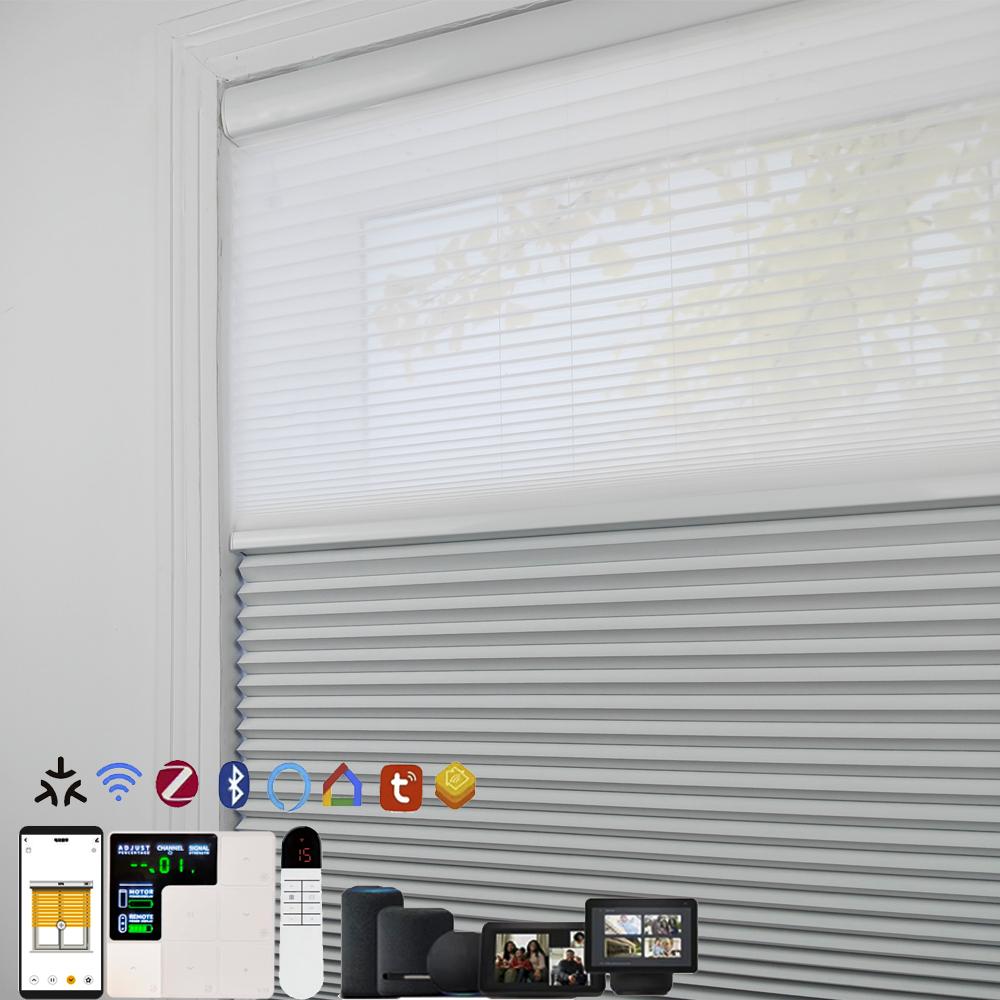
Yes, most OEM programs include battery-powered, rechargeable, or hardwired motor systems from brands like Somfy or Dooya. You can choose remote, app, or voice control integration, and the motor housing can be hidden inside the headrail to maintain a clean look.
Ask for REACH and RoHS compliance for European markets, CPSIA or ASTM F963 if children's rooms are a target, and fire-retardant certifications like NFPA 701 for commercial projects. Factory audit reports (BSCI, SEDEX) are also useful if you require ethical sourcing transparency.
Conclusion
Custom cellular shades aren't just about filling a window hole. The honeycomb structure can be spec'd with different cell depths depending on whether you need more insulation for harsh winters or lighter filtering for mild summers. Fabric choices move away from dull, generic neutrals; think woven textures, heathered tones, and patterns that feel residential, not corporate. Even the shape doesn't have to be a plain rectangle—trapezoids, arches, and angled tops are possible through OEM programs without adding a huge cost premium. That flexibility lets brands offer something that actually fits the architecture instead of forcing every window into the same box.
Controls range from a basic cordless lift to motorized systems that integrate with smart-home platforms, so there's a tier for every customer. For companies looking to build their own line, private label options keep lead times reasonable and don't require massive minimums or redesigns. And the materials can be eco-friendly and child-safe—free of harmful chemicals, cordless by default, and made with recycled content—without filling the catalog with vague sustainability claims. It's a practical blend of function, customization, and responsible manufacturing that actually works for OEM buyers.
Contact Us
Contact Person: Vivien Cheng
Email: [email protected]
Tel/WhatsApp: +86 13751758835
Website: https://www.rollergytech.com/