
High Class Cleanroom Contractor Delivers Precision-Controlled Environments for Critical Industries
2026-09-08
Precision-controlled environments aren't a luxury for critical industries—they're the difference between a successful production run and a costly recall. Yet not all cleanroom contractors deliver the same level of control. GENO Pharmatech has carved out a niche by treating every micron of contamination as a design flaw, not an afterthought. That obsession with precision is exactly what we'll unpack below.
Cleanroom Construction That Leaves Nothing to Chance
Every square inch of a cleanroom is a deliberate decision. From the first architectural sketch to the final pressure differential test, the team maps out airflow patterns, particle counts, and material compatibility long before a single wall panel is installed. That level of planning doesn’t come from guesswork — it’s built on years of understanding how humidity shifts, how static behaves, and how human movement becomes a contamination risk the moment the gowning room door opens.
Construction crews follow a strict sequence that leaves no phase unverified. Floor slabs are checked for flatness to the millimeter, wall systems are sealed with continuous welded joints instead of relying on traditional caulk, and every utility penetration is treated as a potential breach. Temporary barriers stay in place until the room passes particle count testing under dynamic conditions, not just at rest. If a reading falls outside the agreed range, construction stops until the source is found — no exceptions, no “good enough.”
What often gets overlooked is how the room behaves six months after handover. That is why the final walkthrough includes training on cleanroom etiquette, a maintenance schedule tied to real usage patterns rather than generic intervals, and a detailed logbook that owners can actually update. The goal is not just to hand over a room that meets ISO class on paper. It is to hand over a space that stays within spec when production ramps up, staff changes, and the unexpected happens at two in the morning.
Precision Air Handling for Critical Manufacturing
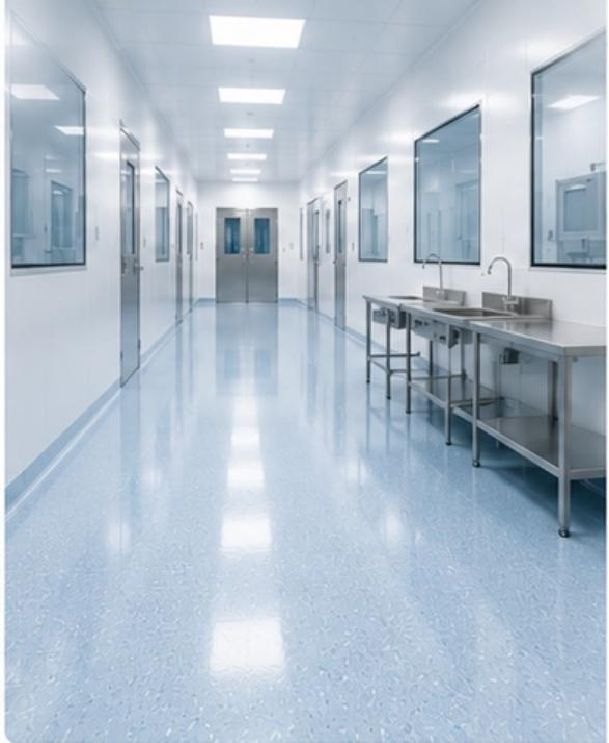
In cleanrooms and microelectronics fabrication, even a half-degree temperature swing or a few stray particles can scrap an entire production batch. Precision air handling systems are engineered to hold tight tolerances—often ±0.1°C and ±1% relative humidity—while laminar airflow sweeps contaminants away from sensitive work zones. Rather than relying on broad HVAC setpoints, these units use variable-speed fans, chilled-water coils with modulating valves, and high-efficiency filtration staged in series to match the real-time load without short-cycling.
What separates robust installations from marginal ones is how they handle part-load conditions and sudden shifts in occupancy or process exhaust. A well-designed system pairs differential pressure monitoring with fast-acting damper actuators, keeping cleanroom cascades intact even when a pass-through opens or a tool ramps down. Redundancy in fan arrays and sensor placement also matters: if one transmitter drifts, the control loop should cross-check against neighboring zones rather than hunting or overcorrecting. This kind of layered response prevents the small oscillations that quietly degrade yield over a shift.
For pharmaceutical filling lines and semiconductor lithography bays, the goal isn't just moving air—it's making the air itself a process variable. That means selecting filters not only by arrestance but by pressure drop at the expected face velocity, and sizing coils for sensible heat ratio instead of total tons alone. Operators who treat air handling as a fixed utility often end up fighting humidity spikes or filter loading with manual overrides. Precision systems, by contrast, log every actuator command and sensor reading, allowing facilities teams to trace a deviation back to a specific damper or coil valve before it becomes a product-quality issue.
The Difference Between Clean and Certified
Clean tends to be a brand-led promise. It usually means a formula skips a handful of ingredients that have fallen out of favor, such as parabens, sulfates, or phthalates, but there is no single rulebook that every company follows. One label's clean moisturizer might still contain synthetic fragrance, while another avoids it entirely. The word sounds reassuring, yet on its own it does not tell you much about what actually went into the jar.
Certified goes a step further because it involves an outside body checking the product against a specific, published standard. That standard might cover organic farming, animal testing, or limits on certain chemicals, and it usually requires documentation, audits, or lab work. When a product carries a certification, you are not just taking the brand's word for it; you are seeing evidence that a separate organization reviewed the claim. Clean is a starting point, but certified adds a layer of accountability that a marketing phrase cannot offer.
Controlled Environments for Semiconductor, Pharma, and Aerospace
Across semiconductor fabrication, pharmaceutical production, and aerospace assembly, controlled environments do more than keep dust out—they stabilize the variables that quietly ruin yield and reliability. Temperature swings, airborne molecular contaminants, and even electrostatic discharge can turn a batch of wafers or a sterile fill line into scrap.
In semiconductor fabs, the cleanroom is tuned for particle counts at the nanometer scale, but just as critical is vibration damping and chemical filtration to protect photolithography steps. Pharmaceutical facilities lean on unidirectional airflow and strict pressure cascades to separate potent compounds and keep aseptic zones viable.
Aerospace work often blends both concerns: satellite optics and propulsion components are assembled in rooms that control not only particulates but also humidity and thermal drift, since a single fingerprint or micro-fiber can compromise a multi-million-dollar instrument.
Why Our Cleanroom Clients Stay for the Long Haul
Long-term cleanroom partnerships are not won by glossy brochures; they are earned through the unglamorous work of keeping documentation accurate, responding to out-of-spec conditions before they become audit findings, and remembering how each client's protocols differ. When a facility manager knows they can reach a familiar engineer at 2 a.m. and not have to re-explain their gowning procedure, switching vendors starts to feel like an unnecessary risk.
Another quiet factor is continuity. Clients stay because the same people who validated their first cleanroom return for re-certifications, understand the history of particle excursions, and can spot a failing HEPA filter trend before it disrupts production. That institutional memory cannot be replaced by a lower bid. It accumulates quietly, year after year, until the cost of leaving is measured not in dollars but in lost context.
Perhaps most telling is what does not happen. There are no sudden scope changes, no newly assigned account managers scrambling to read old reports, no re-litigating of decisions made years ago. Instead, there is a steady rhythm of calibration, testing, and small preventive fixes that keep compliance boring—and boring, in a cleanroom, is exactly what you want.
From First Spec to Final Validation Without Surprises
Most projects fall apart long before the finish line, in the gap between what the original spec promised and what the team actually builds. Closing that gap means treating the spec as a working contract, not a reference document. Every requirement gets linked to a measurable outcome from day one, so interpretation drift never gets a foothold.
The process stays honest through a series of lightweight checkpoints rather than heavy-handed reviews. Each milestone carries acceptance criteria written in the same language as the spec. If a deliverable doesn't meet those criteria at demo time, it doesn't move forward. The goal isn't to catch errors late—it's to stop them from compounding in the first place.
Final validation then becomes a confirmation, not a crisis. There's no last-minute scramble, no surprise edge cases, no rewritten test plans. The product has been checked against the original spec at every stage, so the sign-off reflects what everyone already knows. That's how you get from first spec to final validation without surprises.
FAQ
It means more than just filtered air. A contractor has to manage particle counts, airflow patterns, pressure differentials, temperature, and humidity within tight tolerances—often simultaneously. For example, a semiconductor fab might need temperature stability within ±0.1°C, while a pharmaceutical fill line cares more about microbial contamination and unidirectional airflow. The real skill is balancing all those variables without the systems fighting each other.
You'll find them wherever a stray particle can ruin a batch or a patient. Semiconductors, biotech, pharmaceutical manufacturing, medical device assembly, aerospace optics, and even advanced food packaging. Each has its own quirks: a chip fab worries about sub-micron particles, while a cell therapy lab needs strict biological containment. A good contractor understands those differences instead of applying a one-size-fits-all design.
It starts with the HVAC design—using HEPA or ULPA filters, controlling air changes per hour, and maintaining positive or negative pressure cascades. But it also involves the materials you specify: no shedding surfaces, seamless flooring, and careful detailing around penetrations. Then there's the human factor: gowning protocols, air showers, and sticky mats. The cleanroom itself is only as good as the habits of the people entering it.
Experience in your specific industry, a track record with ISO 14644 or GMP compliance, and the ability to integrate mechanical, electrical, and process systems without creating contamination risks. High-class contractors also think about the lifecycle—how the room will be cleaned, maintained, and validated—not just the initial build. They'll challenge a spec if they see a design that will be hard to clean or operate.
Pressure cascades are the invisible walls. In a sterile filling suite, you want positive pressure to keep unfiltered air from leaking in through door gaps. In a biosafety lab handling pathogens, you need negative pressure to keep dangerous agents from escaping. If the differential is too low, you lose containment; too high, you get turbulence and door operation problems. It's a delicate balance.
Retrofitting an existing building is often harder than starting fresh—you're dealing with low ceilings, structural limitations, and utility conflicts. Another challenge is vibration control for sensitive instruments. And then there's the validation phase: every sensor, alarm, and airflow pattern has to be documented and tested. Rushing that step leads to expensive rework later.
Look beyond the glossy brochure. Ask for references from companies in your exact sector, check their understanding of your process flow, and see if they ask smart questions about your contamination risks. A good contractor will talk about failure modes—power outages, filter leaks, pressure reversals—and how the design handles them. If they only talk about square footage and cost, keep looking.
Yes, and that's often where the real value shows. A high-class contractor will coordinate with third-party certifiers, help you establish monitoring protocols, and train your staff on proper behavior. Some also offer preventive maintenance programs for filters and HVAC systems. Compliance isn't a one-time event; it's a continuous discipline, and the right contractor stays involved after handover.
Conclusion
Building a cleanroom that actually performs under real production conditions takes more than just assembling panels and filters. Every joint, every pressure cascade, every inch of sealed surface has to work as one system. Our team approaches each project as a single, integrated build—no loose ends, no assumptions. Precision air handling sits at the core of this, with airflow patterns, filtration stages, and temperature gradients tuned to the specific process inside. That's the difference between a room that looks clean and one that's certified clean: we design, test, and document to ISO and customer-specific standards, so the certification isn't a sticker—it's a repeatable result. For semiconductor fabs, pharmaceutical suites, and aerospace component lines, that level of control isn't optional. It's the baseline.
Clients stay with us because the first build becomes the reference point for every expansion, retrofit, or new facility. We don't hand over a room and disappear. From the first spec review to final validation, the sequence is mapped, milestones are visible, and surprises are engineered out before they can cost time or money. That predictability builds trust. Over years, our cleanroom clients keep coming back—not because of contracts, but because the environment works exactly as specified on day one, and keeps working through production ramp-ups, audits, and process changes. For critical industries, that continuity is rare and worth keeping.
Contact Us
Contact Person: Amy Yang
Email: [email protected]
Tel/WhatsApp: 008619330882686
Website: https://www.genopharmatech.com/