
Formwork Systems Company: Innovative Solutions for Safer, Faster Concrete Construction
2026-11-16
Concrete construction is evolving, and with it, the demand for smarter formwork systems that cut time without cutting corners. GETO is rethinking how projects of every scale can achieve safer pours and faster cycle times. Whether you're tackling a high-rise core or a sprawling slab, the right formwork solution changes everything from crew fatigue to final finish. This post explores how innovative system design moves beyond traditional methods, helping teams meet tighter deadlines while keeping workers protected. If you're ready to see what's possible when formwork works with you, not against you, keep reading.
Safer by Design, Not by Chance
Most failures that get blamed on human error are really design choices waiting to happen. A guard missing from a machine, a default setting that invites a mistake, a warning label doing the work that a latch should have done—none of these are accidents. When safety is treated as a checklist at the end of a project, the real decisions have already been made. Safer by design means those decisions get revisited early enough to change the shape of the thing itself.
That approach forces a different set of questions. Instead of asking how many warnings to add, teams ask why the hazard exists in the first place. Can the hot surface be shielded? Can the process run at a lower temperature? Can the software refuse an unsafe command rather than merely display a confirmation dialog? Each of these shifts takes effort before a product launches, but that effort pays back in fewer patches, fewer recalls, and less dependence on training that people will forget under stress.
The telltale sign of this mindset is absence: no dramatic near-miss stories, no long list of cautions taped to the side, no special procedure required to keep things from going wrong. The object or system simply behaves safely because its default path is the safe one. That quiet reliability is what separates a design that protects people from one that only hopes they will protect themselves.
Pour Days That Finish Ahead of Schedule
When a pour day wraps up before the clock runs out, it usually means one thing: the crew found their rhythm early and kept it. Instead of fighting the mix or the weather, everything clicked. Forms were set tight, the pump stayed fed, and the finishers moved as a single unit. That kind of efficiency doesn't happen by accident—it's built on clear communication, sharp layout work, and a little bit of luck with the truck schedule.
Finishing ahead of schedule also opens up options. The extra time can go toward cleaning tools properly, walking the slab for low spots, or giving the edges a little more attention before the curing compound goes down. Some crews use the cushion to knock out a small prep task for the next day, which keeps the whole job moving faster than planned. It's a quiet win that rarely shows up in the paperwork, but everyone on site feels it.
Of course, early doesn't always mean easy. It takes discipline to resist rushing just because the clock says there's room to breathe. The best finishers know that a day that ends ahead of schedule is still a day that has to end right. So they hold their standard, double-check the corners, and only call it done when the surface tells them it's ready—not when the schedule says they can leave.
Modular Formwork for Every Shape and Scale
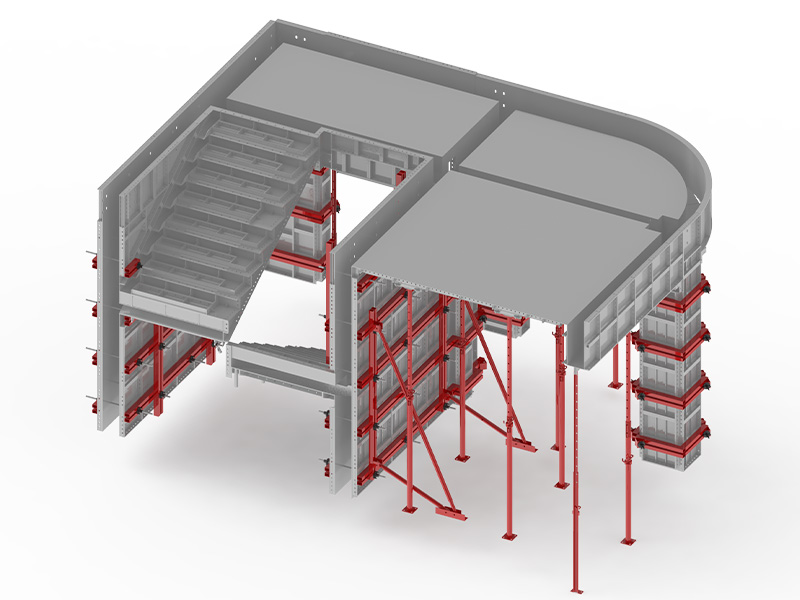
The days of pouring concrete into rigid, rectangular molds are long gone on ambitious sites. Modular formwork breaks the rectangle’s grip, letting you assemble curved walls, angled slabs, and tight corner details without custom-built timber waste. A single kit of interlocking panels and adjustable braces adapts to almost any geometry thrown at it, from a sweeping curved entrance to a sharp-edged retaining wall.
What makes this practicality stick is how the same modules scale up or down. A small crew can manhandle the same panels to form a basement wall one week, then reconfigure them for a 20-metre shear core the next. Because connections are standardized, the learning curve is flat – no specialized joinery or one-off steel fabrication. The real payoff shows up on repeat pours: strip, clean, reset, and move on, with the system holding its shape tolerance pour after pour.
Scale stops being a design constraint when you can add rows and stiffeners in a predictable pattern. For low-rise residential work, a handful of modules handles footings, columns, and lift shafts. For heavy civil jobs, the same logic extends outward – bridge piers, culverts, and large retaining structures benefit from the same adaptability. The formwork doesn’t care whether you’re casting a 200mm garden wall or a 6-metre thick transfer beam; it just needs the right configuration of the same basic parts.
Why Reusability Changes the Cost Equation
The first time you build something meant to be reused, the price tag rarely feels like a bargain. You're not just solving the problem in front of you—you're anticipating variations, tightening interfaces, and writing tests that cover scenarios nobody has asked for yet. Compared with a quick, locked-in implementation, the reusable version tends to take longer and cost more to ship.
That changes once the asset enters a second or third project. The original design and testing effort gets amortized across multiple deliveries, so each new use costs a fraction of building from scratch. Maintenance follows the same curve: a bug fixed in one shared module disappears everywhere it's used, while duplicated code would need the same repair again and again. Reusability doesn't eliminate short-term costs, but it steadily replaces repeated costs with a one-time investment that keeps paying back.
Handling High-Pressure Pours Without the Risk
High-pressure pours demand a level of respect that goes beyond standard operating procedures. The sheer force behind the material can turn a minor oversight into a catastrophic failure in seconds. Whether you're dealing with concrete, chemicals, or molten metals, the key to managing this risk is not just wearing the right gear—it's understanding exactly where the pressure is going, how it behaves under sudden changes, and what fails first when something goes wrong. Experienced operators often rely on a pre-pour checklist that includes hose integrity, coupling tightness, and a visual scan for weak points that might not show up on a pressure gauge.
One of the most overlooked aspects of safe high-pressure work is the human factor. Fatigue, distraction, or a rushed pace can easily lead to a miscalculated release or an improperly seated valve. That's why many crews adopt a two-person verification system for critical connection points, and why slow, deliberate movements are encouraged even when the schedule is tight. Personal protective equipment should be treated as the last line of defense, not the first—your primary protection comes from controlling the pressure at the source and knowing exactly where every drop of material is expected to go.
Finally, a well-rehearsed emergency shutdown procedure can make the difference between a contained incident and a full-blown accident. Every member of the team should know where the kill switches are, how to bleed off pressure safely, and what to do if a hose whips or a coupling blows. Post-pour debriefs, even after uneventful operations, help refine the process and catch subtle issues before they escalate. The goal isn't just to survive the pour—it's to build a reputation for running high-pressure jobs that finish cleanly, without surprises, and without anyone getting hurt.
Field-Proven Systems for Complex Concrete Work
Field-proven systems for complex concrete work rarely emerge from a single lab test or a clean spec sheet. They develop on congested high-rise decks, inside deep foundation pours, and across bridge segments where the mix, the formwork, and the placement method have to survive real temperature swings, pump distances, and crew schedules. A mix that performs well in a controlled trial often fails under a 300-meter vertical pump unless the aggregate shape, viscosity modifier dosage, and set retarder are adjusted based on data from previous jobs that pushed the same limits.
The formwork and placement side is just as telling. Systems that hold up under complex concrete work rely on pressure-monitored modular panels, pour-rate limits tied to actual form deflection readings, and vibration patterns learned from dense reinforcement layouts rather than generic guidelines. In massive placements, field-proven approaches use embedded temperature sensors to decide when to start curing blankets or switch to chilled mixing water, avoiding thermal cracking that no amount of post-pour repair can fully hide.
What separates these systems from ordinary practice is that they get refined after every pour. Site teams keep logs of cold joints, honeycombing, and pump blockages, then feed those back into the next mix design or placement sequence. Over time, the result is a set of working rules—sometimes informal, often project-specific—that consistently deliver the required finish, density, and structural integrity on complicated concrete work without relying on guesswork.
FAQ
Instead of one-size-fits-all panels, we map each pour sequence and adjust connection points to match the actual site geometry. That cuts the need for on-site improvisation, which is where delays and safety issues usually creep in.
It depends on the structure, but on mid-rise projects we typically see a 30–40% reduction in forming time because panels are lighter and have fewer tie points. One contractor finished a 12-story core two weeks ahead of schedule after switching.
Every working platform includes integrated toeboards and guardrails that stay in place during lifting. We also use non-slip plywood faces and color-coded locking mechanisms so workers can verify connections at a glance.
Yes, we supply custom steel and timber-faced forms for curved walls, sloped columns, and unusual facade details. The engineering team pre-assembles complex sections in the yard to catch fit issues before they reach the job site.
We assign a field engineer for the first few pours on every project. They train the crew, adjust formwork alignment, and stay on call until the site superintendent confirms the cycle is running smoothly.
The upfront rental is comparable to conventional formwork, but the real savings come from fewer labor hours and less rework. Smaller crews can handle larger areas, and the panels return usable for multiple projects before major refurbishment.
Mostly visual checks and occasional cleaning of the contact faces. The steel frames are hot-dip galvanized, so rust is rarely an issue, and we provide a simple checklist that takes about ten minutes per shift.
We run finite element analysis on every custom configuration and test critical connections at 1.5 times the expected concrete pressure. If a pour plan changes, we re-check the layout before giving the go-ahead.
Conclusion
Formwork Systems Company builds its reputation on formwork that removes guesswork from concrete construction. The safer by design approach means every panel, tie, and connection is engineered for the pressures of real pours, so crews work with confidence rather than depending on chance. Modular formwork adapts to slabs, walls, columns, and unusual geometries without forcing custom fabrication, which keeps pour days finishing ahead of schedule. When a high-pressure pour is on the line, the system's rated components and locking mechanisms hold steady, letting teams focus on placement rather than worrying about blowouts.
Reusability is where the cost equation shifts. Instead of single-use forms that end up as scrap, these modular frames cycle through dozens of pours with little more than cleaning and light maintenance. That durability lowers both material expenses and downtime between jobs. Field-proven systems have handled complex concrete work on tight core walls, long-span beams, and foundation work with exposed finishes, proving that speed and safety don't have to trade off against quality. For contractors, that means bidding on more challenging projects without expanding the crew or extending the timeline.
Contact Us
Contact Person: Quanhui Nian
Email: [email protected]
Tel/WhatsApp: 8618070545691
Website: https://www.getoglobal.com/