

China Power Transmission Tension Tower Company Builds the Backbone of Modern Power Grids
2026-08-21
Every modern grid stands on steel that doesn't bend under pressure. In China, one name keeps appearing where reliability is non-negotiable: Anbang. As power demand surges and renewable sources scatter across remote terrains, transmission tension towers have quietly become the backbone of energy delivery. This post looks at how a focused manufacturer is shaping that backbone, one precision-built tower at a time.
The Silent Strength Behind Every High-Voltage Line
High-voltage transmission lines rarely draw attention to themselves, yet their quiet presence masks an extraordinary capacity for endurance. The steel-reinforced aluminum conductors, suspended from porcelain or composite insulators, are engineered to carry immense electrical loads while facing temperature swings, ice accumulation, and gale-force winds. Their strength is not announced through motion or noise, but through the simple fact that they hold steady year after year, even when nature does its worst.
The phrase “silent strength” also speaks to the remarkable reliability of these systems. With no moving parts to wear out, a well-built line can remain in service for decades, needing only periodic inspection and tightening. Each tower, clamp, and insulator works together to maintain precise clearances and prevent flashovers, doing its job without fanfare. This quiet dependability is what keeps hospitals running, factories humming, and homes warm at night.
Behind every high-voltage line is a discipline of careful calculation: sag must be balanced against thermal expansion, tension distributed evenly across uneven terrain, and protective coatings chosen to resist corrosion. These invisible details form the backbone of a grid that rarely fails. The next time you see a line stretching toward the horizon, remember that its greatest power is not the current it carries, but the silent endurance built into every component along the way.
Tension Tower Design That Keeps Power Flowing Across Regions
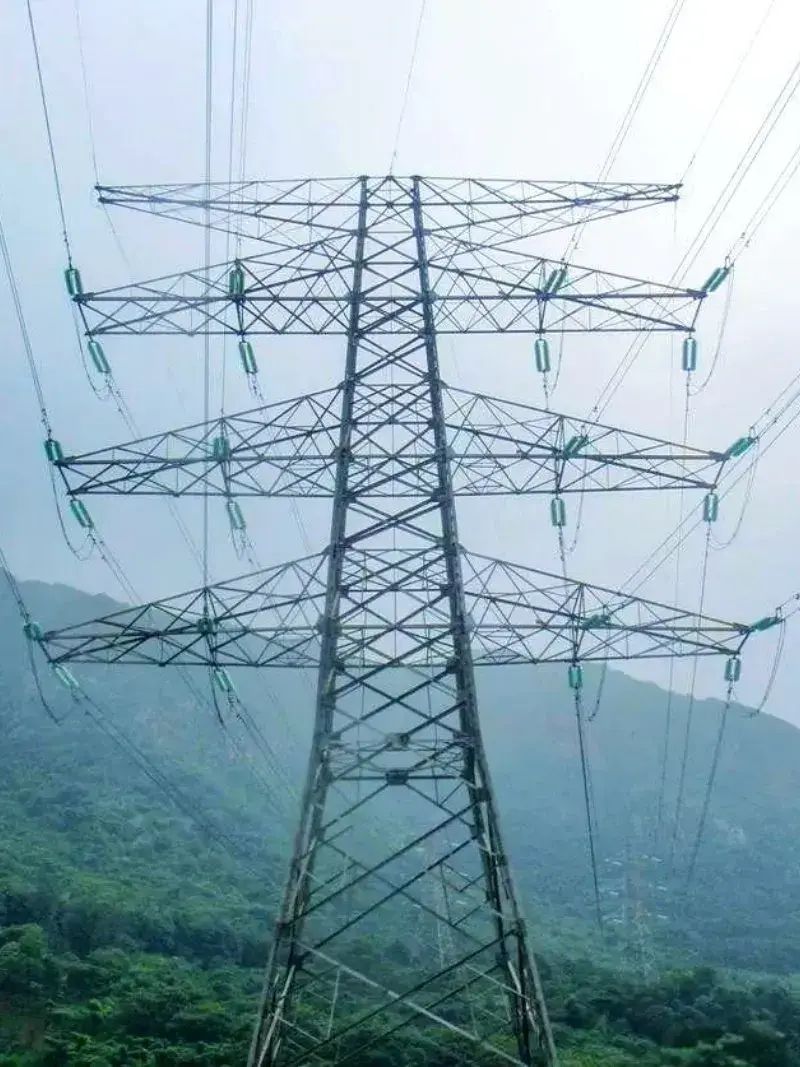
Tension towers—often called strain or dead-end towers—serve as the mechanical anchors of a transmission line. Unlike suspension towers that simply carry conductor weight, these structures are built to absorb the full longitudinal pull of conductors at angle points, river crossings, or line ends. By pinning the conductors at fixed intervals, they split a long route into manageable tension sections. This segmentation is what keeps a single equipment failure or a broken conductor from cascading into a regional outage. The tower bodies typically use heavier steel profiles, and the insulator strings hang horizontally or in a V-shape, redirecting load into the ground instead of letting it travel along the line.
Across regions with rugged terrain or extreme weather, the design must account for wind-induced sway, ice loading, and thermal expansion of conductors. Engineers often use high-strength weathering steel and hot-dip galvanizing to resist corrosion in coastal or industrial environments. Some modern tension towers integrate damping systems and strain gauges that feed real-time data back to control centers, allowing operators to spot abnormal tension shifts before they cause damage. Smart monitoring and robust materials work together to keep the power corridor alive across cities, states, and even countries.
Materials and Welds That Withstand Decades of Service
Selecting the right base metal is only half the story. In sour service or chloride-rich settings, duplex and super duplex stainless steels hold up because their mixed microstructure resists pitting and stress corrosion cracking far better than conventional 300-series grades. The filler metal has to line up with that chemistry, or the weld zone becomes a galvanic cell waiting to fail. On older pressure vessels, we have seen 2205 repairs outlast the original 316L shell by a wide margin, largely because the weld deposit retained its ferrite-austenite balance instead of drifting into a brittle phase.
Welding procedure has just as much influence on longevity as the alloy itself. Too much heat input can sensitize stainless steel or coarsen the heat-affected zone in low-alloy steels, while too little leaves lack-of-fusion defects that act as crack initiators. Post-weld heat treatment is not a universal fix; for some precipitation-hardening nickel alloys, a rapid quench after solution annealing does more for long-term toughness than a slow furnace cool. The shops that get this right typically record preheat, interpass temperature, and travel speed for every pass, not just the final bead.
Decades of service are earned through inspection discipline as much as through metallurgy. A pipeline girth weld in the North Sea might see 30 winters of wave loading without issue if it was radiographed and then checked with phased array ultrasonics at regular intervals. The best records come from facilities that treat weld maps as living documents, updating them after each repair and using the data to predict where fatigue or corrosion is likely to concentrate next. That kind of attention keeps a weld from becoming the weak link in an otherwise sound structure.
Inside the Journey from Project Blueprint to Tower Assembly
The shift from a set of approved drawings to a standing tower rarely follows the tidy sequence you might imagine. Once the blueprints are stamped and the first steel shipments hit the laydown yard, the actual work starts with layout and sequencing. Crews mark anchor bolt patterns on the foundation, often finding that field measurements drift a few millimetres from the design. Those small mismatches have to be resolved before the first column can go vertical, and that back-and-forth between the office and the field sets the tone for everything that follows.
Assembly becomes a rhythm of lifts and checks. A crane raises a section, riggers guide it into position, and surveyors confirm plumb and torque before the next piece leaves the ground. Weather has a way of interrupting more often than the schedule allows, and a late delivery of flange bolts can idle an entire crew for an afternoon. Yet each completed lift narrows the gap between the tower that existed only on paper and the one now throwing a long shadow across the site.
Precision Manufacturing That Reduces Grid Downtime
Every component we produce begins with tight tolerances measured in microns, not millimeters. On the factory floor, this means flanges seat perfectly the first time, conductors align without forcing, and insulation layers don't require field trimming. When parts fit exactly as designed, maintenance crews spend fewer hours troubleshooting intermittent faults and more time restoring service after planned outages.
Our machining centers hold dimensional stability across temperature swings that would distort ordinary alloys. We pre-age castings, stress-relieve weldments, and lap sealing surfaces to a flatness that prevents partial discharge. The result is a breaker that closes with authority at -40°F and opens without hesitation after a lightning strike, keeping feeders energized instead of waiting for a replacement part that never quite matches the original.
Reduced downtime isn't a claim here; it's a consequence of rejecting anything that measures outside a 0.0005-inch window. We scrap more material than most shops would ever attempt to rework, because a bushing that arcs over at 3 a.m. costs a utility more than the entire batch it came from. That discipline, repeated across thousands of units, is why our hardware stays in service for decades while the grid around it keeps humming.
A Utility Partner for Expanding Renewable Energy Reach
Scaling renewable energy isn't just about building more solar panels or wind turbines—it hinges on having a utility partner that understands how to move that power from the edge of the grid to the people who need it. From negotiating interconnection agreements to managing voltage fluctuations on aging feeders, the right partner handles the unglamorous grid work that often determines whether a project reaches its full output or stalls in permitting limbo.
What sets a genuinely capable utility collaborator apart is not a pile of case studies but a working knowledge of local infrastructure constraints. They know which substations have headroom, where reverse power flow might trip protective relays, and how to stage upgrades without forcing the community to bear lengthy outages. That kind of granular, site-level awareness can't be pulled from a spreadsheet; it comes from years of operating inside the same load zones and talking to the field crews who actually flip the switches.
The payoff shows up in quieter ways: a community solar garden that reaches commercial operation two quarters early because the interconnection study was anticipated, a rural co-op that avoids a costly transformer replacement by shifting export schedules to match real-time demand curves. These are not headline-grabbing wins, but they compound into a renewable portfolio that expands reliably rather than relying on subsidies or wishful forecasting.
FAQ
It designs, fabricates, and often installs the lattice steel structures that hold high-voltage conductors under tension—essentially the skeletal frame keeping long-distance power lines stable across rough terrain and harsh weather.
Because they carry the mechanical load of conductors and ground wires, especially at angle points or dead-ends, so the grid cannot maintain line tension or route electricity over mountains, rivers, and highways without them.
Reputable firms usually follow IEC, ASTM, or EN standards, run in-house galvanizing and load-testing, and provide full material traceability—from raw steel coils to bolt torque reports—so overseas utilities can audit every batch.
Hot-dip galvanized high-strength steel, typically Q355 or Q420 grades, is the norm; some companies also offer duplex coatings or weathering steel for coastal or industrial zones where salt spray accelerates corrosion.
Most work from client-specific drawings and line loading data, often using PLS-CADD or similar software to optimize tower weight and geometry, so each project gets a tailored solution rather than an off-the-shelf model.
Full-scale prototype assembly and load testing up to the design failure limit are common, along with dimensional checks, weld inspections, galvanizing thickness tests, and sometimes dynamic wind tunnel analysis for critical lines.
Towers are typically bundled and containerized or shipped as breakbulk with pre-assembled panels, and suppliers coordinate with freight forwarders to handle port clearance, inland transport, and site delivery in remote locations.
There's a push toward higher voltage UHV lines, lighter high-strength steel grades, digital twin modeling, and automated welding lines, plus more pre-assembly to reduce on-site labor and shorten project schedules.
Conclusion
Behind every high-voltage corridor stretching across mountains and plains, tension towers do the quiet work of keeping conductors stable under wind, ice, and load shifts. At China Power Transmission Tension Tower Company, that silent strength is engineered from the first line of a project blueprint. Design teams tailor each tower's geometry to terrain, span length, and regional weather, so power keeps flowing across provinces without the weak points that cause cascading failures. Materials are not chosen casually—high-grade steel plates and welding rods are matched to the stress each joint will carry. Full-penetration welds, tested against decades of thermal cycling and corrosion, turn individual steel members into a lattice that can stand for thirty or forty years with minimal intervention.
From blueprint to assembly, the company runs a tight sequence of cutting, punching, galvanizing, and trial-fit checks. Computer-guided cutting and robotic welding reduce dimensional drift, which means towers go up faster on site and utilities face fewer outage windows for maintenance or emergency replacement. This precision also helps renewable energy developers push wind and solar generation into distant load centers. Instead of treating each tower as a commodity, the team treats it as a load-bearing link between generation and demand—so a new interconnector or a repowered wind farm has a structural partner that will not become the weak point of the grid.
Contact Us
Contact Person: antor khan
Email: [email protected]
Tel/WhatsApp: 8613863903569
Website: https://www.qdabtower.com/