

Carousel Rotomolding Machine Solutions for High-Volume Plastic Part Production
2026-11-17
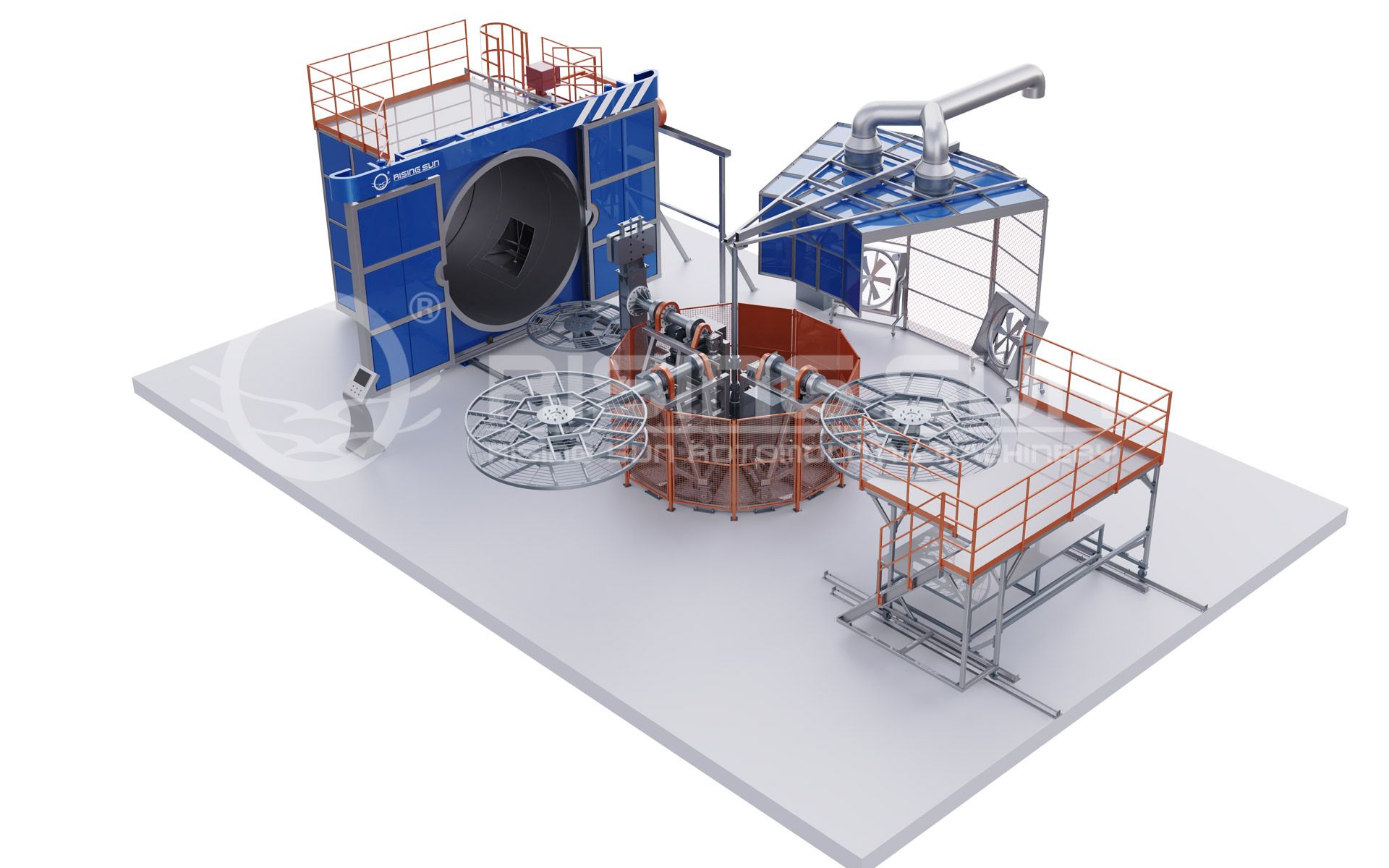
It is easy to assume that carousel rotomolding is only suited to short runs or oversized hollow parts. That assumption falls apart once cycle times, cooling rates, and multi-station sequencing are engineered for steady output. Carousel rotomolding machine solutions for high-volume plastic part production change the conversation from “can we make it” to “how many can we ship this week.” At Rising Sun, we focus on the details that turn a rotating arm into a repeatable production system: balanced heating, faster part turnover, and tooling designed for real throughput. This post breaks down what high-volume carousel molding actually requires and where many production lines leave capacity on the table.
Carousel Machine Configurations That Hold Up Under High-Volume Demands
High-volume operation exposes weaknesses that a standard carousel setup hides. Frames built from lighter channel stock may pass a low-cycle test, but once the carriage starts reversing every few seconds, micro-flex in the uprights shows up as tracking drift and premature tire or bearing wear. Reinforced corner gussets, a wider bolt pattern on the base plates, and a stiffer mast section matter more than the motor nameplate when the machine runs across two shifts.
Drive configuration also shifts under sustained demand. A belt-driven carriage can work for moderate pick rates, but continuous start-stop cycles generate heat in the tensioner and stretch the belt enough to affect stop accuracy. Direct-drive or positive-chain setups with a well-sized brake resistor tend to hold position longer without the control loop hunting. It is also worth specifying high-cycle-rated sensors at the load and unload stations, because position verification failures typically climb after the first few hundred thousand cycles, not during commissioning.
Oven Temperature Profiling for Consistent Wall Thickness at Speed
Maintaining consistent wall thickness at higher line speeds usually comes down to how evenly the polymer reaches forming temperature. A single barrel or die setpoint rarely tells the whole story because the outer surface heats faster than the core, and that gap widens as throughput increases. Oven temperature profiling splits the heating length into controlled zones so the material is brought up to temperature in stages rather than blasted with heat at the entry.
The most useful profiles are built around measured melt or parison surface temperatures, not just air temperatures inside the oven. When line speed rises, dwell time drops, so early zones often need a slight boost to overcome the colder core while the final zone may be pulled back to avoid overheating the surface. That balance helps prevent thin spots caused by uneven stretching and keeps the wall from drifting off-center.
It also pays to store profiles against specific speeds and product dimensions. A curve that works at a moderate rate often fails when the line accelerates because the same heater settings no longer deliver the same thermal history. Adjusting each zone based on infrared readings or thermocouple feedback closes that loop and reduces scrap during ramp-ups and changeovers.
Changeover Routines That Keep Multi-Station Machines Running Longer
A shift rarely ends cleanly for multi-station machines. Operators get pulled away, material runs low, and the next setup starts as a scramble. The machines that keep running longest share a quieter habit: changeover is treated as a rhythm rather than an interruption. Instead of a checklist nobody reads, the crew walks the line together for ninety seconds, pointing at every clamp, probe, and magazine that will need attention. The goal is not speed. It is removing the guesswork that turns a twenty-minute swap into a forty-minute stall.
One useful trick is to stage changeover parts by station number, not by part name. A labeled cart with bins ordered left to right matches the machine layout, so hands never hunt for a collet or a gripper finger. Teams also record the two most frequent setup delays on a whiteboard near the machine—not as a blame list, but as a visible cue for the next shift. Most surprising is how often the delay is not a broken tool but a missing hex key or a sensor that needed a two-second wipe.
The payoff shows up in accumulated runtime, not in a single heroic effort. When changeover becomes boring and predictable, multi-station machines stop hemorrhaging minutes between jobs. Operators begin to trust the next handoff, and that trust keeps spindles turning long after the shift bell. The simplest rule is to finish every setup as if the next person stepping in has never seen the machine before—because sometimes, that is exactly the case.
Independent Arm Control for Mixed Product Batches
Mixed batch production usually falls apart when every station has to follow the same beat. One product needs an extra dispense pass, another has a taller cap, and suddenly the whole cell is waiting instead of working. Independent arm control removes that shared pulse. Each arm can run its own routine, switch tools on its own timing, and finish a cycle without pulling the next arm off track.
On the floor this shows up as one arm placing a liner into a wide jar while the neighboring arm seats a sprayer on a slim bottle, and a third arm handles a completely different SKU that only appears every few cycles. The motion controller keeps the spacing safe and tracks each product as an individual unit, so the line no longer has to pretend every item in the batch is the same shape or needs the same process time.
The biggest difference comes with short runs and mid-shift changeovers. An operator can edit one arm's pick points or torque settings while the rest of the cell keeps running, then release the changed routine when the next mixed case arrives. That makes small batches easier to justify and lets a new package variant enter the schedule without stopping the whole line for a full reprogram.
Cooling Rate Adjustments That Reduce Warp Without Adding Cycle Time
Most molding teams assume that fixing warp means leaving the part in the tool longer. That logic overlooks a more direct lever: shifting where and how fast heat leaves the plastic, not simply how long it stays under clamp. A uniform wall section rarely cools uniformly because gate locations, flow paths, and steel mass all create hot spots. By targeting those hot spots with higher-conductivity inserts or locally reduced cooling-channel spacing, you can pull down the temperature of thick bosses and ribs faster than their surroundings, shrinking the differential that drives post-ejection distortion. The total cycle time stays flat because you are rebalancing heat removal rather than extending it.
Another route is to exploit staged coolant temperatures during the same cooling phase. Briefly running a lower coolant setpoint in the first few seconds builds a rigid skin quickly, then switching to a warmer setpoint lets the core relax without adding seconds to the timer. This pulse-style approach works especially well for glass-filled materials where the skin freezes fast and the interior shrinks later. Some shops implement it with a dual-temperature manifold and a timer, no mold changes required. The paperwork shows the same overall cooling duration, but the part comes out flatter because the internal stress profile never gets a chance to lock in a severe gradient.
Pay attention to coolant delta-T across the circuit. A large temperature rise from inlet to outlet means one side of the cavity sees colder steel than the other, and that imbalance often shows up as bow or twist. Raising flow rate or splitting a long loop into parallel shorter loops can cut that delta-T dramatically without touching cycle time. If the problem is a deep rib or a tall boss, a bubbler or a baffle brings coolant directly to the heat concentration instead of relying on conduction from a distant drilled line. In some cases, adding a thin layer of copper alloy behind a hot detail can pull heat sideways almost as well as adding another water line, and it costs less downtime to implement.
Floor Space, Crew Size, and Output Planning for Carousel Rotomolding
A carousel machine has a way of filling a bay faster than the spec sheet implies. Beyond the rotating arm diameter, you need clear swing space around the oven and cooling stations, room for mold carts and raw material staging, and enough aisle width for a forklift or pallet jack during changeovers. Overhead clearance matters too, especially if the arms lift large molds or if ducting and utilities run above the machine. Placing the loading and unloading zones at opposite ends of the carousel tends to keep traffic from tangling, but that also stretches the overall footprint.
Crew size usually looks lean on paper and gets heavier in real operation. A single skilled operator can handle loading, unloading, and basic quality checks during steady runs, but changeovers, mold sticking, or trimming heavy flash quickly pull that person away from the cycle. Many shops settle on two people per shift for a four-station carousel: one managing the molds and machine, the other handling material flow, part finishing, and secondary tasks. Cross-training is what keeps the line moving when someone is pulled to another area.
Output planning starts with the slowest station, not the number of arms. Heating and cooling times set the rhythm, and adding more arms only helps if the oven and cooling zones can keep pace. Count realistic cycles per hour by part weight, wall thickness, mold cavities, and material, then shave off time for changeovers, scrap, and the occasional rework. A common mistake is treating a three-arm carousel as three times the output of a single arm; in practice the gain is usually lower once cooling dwell and operator attention are factored in.
FAQ
The biggest advantage is the overlapping heating, cooling, and loading zones. While one arm is in the oven, another is being cooled and a third is being unloaded or charged, so the line never idles. That parallel workflow, combined with repeatable arm indexing, allows consistent mold rotation and faster turnaround than shuttle or open-flame machines, especially when you are making the same family of parts repeatedly.
It splits the process into distinct stations that operate at the same time. A three-arm machine, for example, keeps one arm in the oven, one in the cooling bay, and one at the service station. The cycle-limiting step is usually the longest station, often cooling or heating, so engineers can tune air flow, water mist, or oven temperature to shorten that step without forcing the other arms to wait. That directly raises the number of parts per shift.
Agricultural equipment, water storage, material handling, recreational products, and automotive components are common users. Any application that needs durable hollow or foam-filled parts like tanks, bins, cooler bodies, fenders, or ductwork benefits from the large shot sizes and low-stress walls a carousel machine can deliver at production volumes.
Melt flow index, particle size distribution, and oxidative stability matter a lot. Polyethylene is the most common choice because it grinds well, has a wide processing window, and tolerates long oven dwell times. For higher volumes, you want a material that flows evenly across the mold surface, does not degrade during extended heating, and packs consistently from shot to shot so wall thickness remains uniform.
Heating and cooling are usually the longest phases, so they need to be matched to avoid a bottleneck at one station. If cooling takes eight minutes and heating takes twelve, the whole machine cycles at twelve minutes unless cooling is made more aggressive. Adjusting air velocity, using water mist, and managing mold surface temperature help bring the two phases closer together and keep all arms moving on a predictable index.
Mold parting lines, venting, and mounting points on the spider plate all influence how well the part forms at faster cycle times. Good venting prevents pressure buildup and blowback, while balanced mold placement reduces uneven wear and helps each cavity receive uniform heat. Details like well-designed drop boxes or internal air systems can also improve consistency when you push cycle times down.
Yes, within the limits of the process. Threaded inserts, kiss-offs, ribs, and undercuts can be incorporated, but the mold must be designed so powder reaches those areas and cooling does not lock in excessive warp. In high-volume production, features are often simplified or staged to maintain demolding speed and reduce manual intervention, but complex shapes are absolutely possible with careful mold engineering.
Regular inspection of arm bearings, drive chains, gas lines, and burner operation prevents most unplanned downtime. Mold surfaces should be checked for release-agent buildup or damage, and thermocouples need calibration so temperature readings stay accurate. Since these machines run hot and rotate constantly, a weekly alignment check on the indexing system and lubrication of pivot points helps keep cycle times stable and parts repeatable.
Conclusion
High-volume rotational molding rarely comes down to one smart feature. It depends on how the carousel layout, heat control, and crew movement line up with the parts being molded. A machine with multiple stations earns its floor space when the configuration fits the product mix rather than forcing every mold through the same routine. Some jobs need four or six arms; others need independent arm control so a large tank and a small bracket can run side by side with different heating and cooling profiles. Oven temperature profiling is where consistency is won or lost. If the heat is not managed zone by zone, thin walls and flash show up long before anyone notices a change in cycle time. Treating the oven as a group of controlled zones, not one hot box, keeps wall thickness steadier across long production runs.
Changeover and cooling are the quieter parts of high-volume work, but they often determine whether a multi-station machine stays productive. Quick mold changes, saved temperature recipes, and clearly marked service points prevent small delays from becoming lost shifts. Cooling should be staged and adjustable, because pulling heat out too aggressively can cause warp, while cooling too slowly adds unnecessary cycle time. Controlled airflow and adjustable exhaust let each mold cool at a rate that protects the part without slowing the line. Beyond the machine itself, floor space, crew size, and output planning need to match the carousel footprint. A tight layout with clear material flow and one or two well-trained operators can often outproduce a larger installation that was never tuned to the real schedule.
Contact Us
Contact Person: Sharon Zhu
Email: [email protected]
Tel/WhatsApp: 8615712666272
Website: https://www.risingsunroto.com