

Best Industrial Casters Wholesale: A Buyer's Guide to Durable Mobility Solutions
2026-11-27
Finding casters that can survive a warehouse floor without wobbling loose after three months isn’t as straightforward as most catalogs suggest. A buyer’s real job is sorting through load ratings, wheel compounds, and mounting options that rarely behave the same way once they’re bolted under a live cart. This guide walks through what actually matters for durable mobility solutions, including where CMCL fits into an industrial supply chain that can’t afford frequent replacements.
Load Ratings That Match Real Cart Weights
Most listed cart capacities fall apart under daily use because they assume a static, evenly distributed load. A cart carrying 400 pounds of loose boxes, tools, or bagged material behaves very differently than a test weight placed at the center of a deck. We set ratings around that messier reality, not a controlled scenario.
The number we print reflects what the cart can handle after factoring in the extras that usually get ignored: uneven weight shifts, curb bumps, slight drops from loading docks, and the force of someone leaning on a handle mid-turn. If a frame, caster, or shelf can't hold up to those conditions at the stated weight, we lower the rating instead of padding the brochure.
That approach leaves less room for surprises. Teams can load to the listed figure and still expect predictable steering, stable braking, and no bowed shelves at the end of a shift. The rating may look conservative on paper, but it matches what the cart actually goes through.
Wheel Materials for Floors That Take a Beating
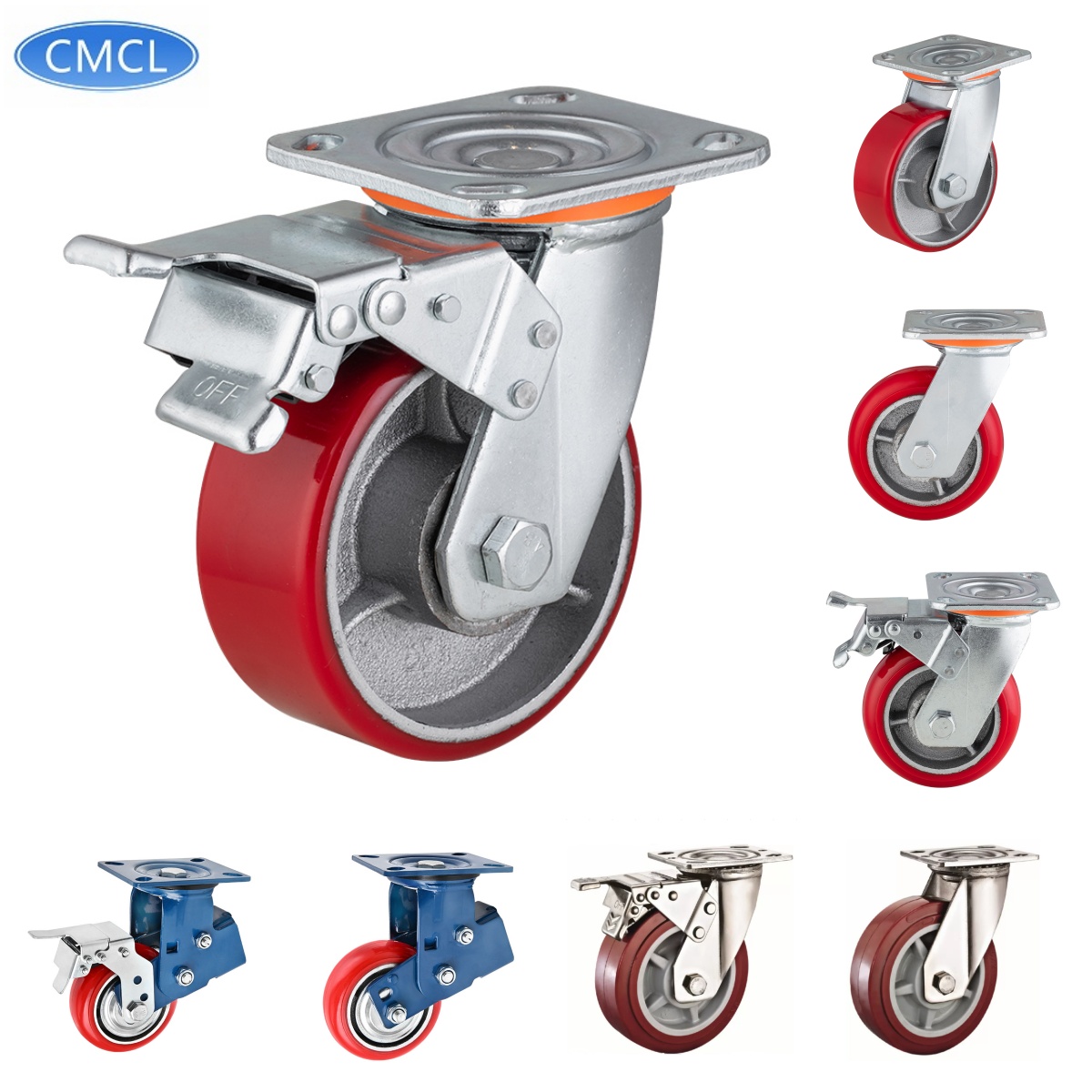
Concrete and rough industrial flooring chew through ordinary casters in weeks, so the wheel material has to be chosen with the same care as the floor coating itself. For surfaces that see daily forklift traffic, dropped tooling, and oil spills, polyurethane on a cast iron core holds up best. The metal core keeps its shape under heavy static loads, while the polyurethane tread absorbs shock without chunking out. Harder durometers, around 90A to 95A, roll easier under load and resist flattening when a cart sits parked overnight. Skip anything softer than 80A on this kind of floor unless you enjoy replacing wheels every quarter.
Forged steel wheels are the blunt instrument of the group. They handle furnaces, weld splatter, and metal chips that would shred rubber or nylon in a single shift. The tradeoff is noise and floor marking, so they only make sense where the floor itself is sacrificial or already heavily scored. For mixed environments where you need some floor protection but can't sacrifice durability, phenolic resin wheels offer a middle path. They are harder than polyurethane, quieter than steel, and shrug off most chemicals. Just be aware that phenolic can chip if it catches a sharp expansion joint at speed.
One often overlooked factor is how the wheel material interacts with debris already on the floor. A gritty concrete slab covered in fine sand acts like sandpaper on softer treads. In those cases, a slightly softer polyurethane actually wears longer than a hard one because it deforms around the grit instead of grinding it into the surface. Choosing wheels for punishing floors isn't about finding the toughest material in a lab test. It's about matching the material to the specific abuse your floor dishes out, from impacts and chemicals to quiet abrasion that slowly eats away at the wrong compound.
Mounting Styles That Stop Wobble Early
A wobbly mount rarely starts as a dramatic failure. It begins with a barely visible gap between bracket and rail, a single bolt seated at a slight angle, or a clamp that only grips on one side. The mounting styles that stop wobble early share a common trait: they remove that first millimeter of play before it becomes a rhythmic shake. Instead of relying on a flat plate and hope, these designs use tapered seats, captured hardware, or overlapping flanges to force the connection into alignment during assembly. Once the fastener reaches torque, the parts are already locked against each other, leaving no room for the back-and-forth motion that wears everything loose.
Some of the most effective options trade a single large contact patch for several smaller, offset pressure points. A three-point or four-point mount can hold a rail or plate steady even when the base surface is not perfectly flat. The outer points settle first and act like a tripod, while the inner points pull the assembly down into tension. This staged contact makes it harder for a wobble to develop because the load path does not hinge on one bolt or one edge. When vibration hits, it gets absorbed across the whole pattern rather than concentrated at the weakest corner.
There is also a practical difference in how these mounts are installed. The best anti-wobble styles give clear physical feedback: a snug taper that bottoms out, a shoulder that stops the clamp at the right depth, or a wedge that visibly closes as you tighten. That removes guesswork. If the installer can feel and see the mount seat fully, the connection is less likely to sit just off enough to rattle later. In field use, that early certainty matters more than a clever design on paper, because it prevents the tiny misalignment that turns into a loose, noisy joint after a few hundred cycles.
Bearing Choices Most Buyers Skip
Walk into any supply aisle and you'll see the usual suspects: deep groove ball bearings, tapered rollers, pillow blocks. They're safe, familiar, and fine for most routine setups. But sticking to those defaults quietly closes the door on designs that handle heat better, shrug off misalignment, or simply last longer under loads nobody bothered to recalculate. The bearings most buyers skip aren't exotic—they simply solve problems the common catalog picks ignore.
Take full-complement cylindrical roller bearings, for instance. Without a cage, they pack in more rollers and carry heavier radial loads in the same envelope. Many engineers shy away because they associate them with lower speed limits, yet in oscillating or slow-turning heavy equipment, that trade-off buys a much longer fatigue life. Similarly, self-aligning ball bearings rarely make the cut because standard inserts seem cheaper—until shaft deflection or mounting surface irregularity turns those savings into repeated replacements. A double-row self-aligning unit absorbs that movement instead of fighting it.
Then there are thin-section bearings and hybrid ceramic options. Thin-section rings keep weight and space down in robotics and medical devices, but they get overlooked because standard charts don't highlight them. Hybrid bearings with ceramic balls handle electrical pitting and high-speed heat far better than all-steel versions, yet they still sit in the "special order" corner of many minds. None of these choices require a dramatic redesign—just a second look at what the application actually needs rather than what the shelf always offers.
Wholesale Lots Without Spec Surprises
The whole point of buying wholesale is knowing what will show up on the dock. Every lot in this range is pulled against a fixed spec sheet, so the measurements, materials and finish you approve are the ones that arrive. There is no quiet substitution, no last-minute color shift, and no “close enough” grading that leaves you explaining differences to your own buyers.
That consistency carries through from sample to bulk. A carton opened at random should match the reference piece on your desk, down to thread color and hardware weight. If a label says a case contains sixty units of one style, it is sixty units, not a mix of lookalike leftovers. When packing lists and carton counts stay boring and predictable, inventory moves without the usual repair work.
For anyone who has had to rework an order because the specs drifted after approval, the value here is simple: fewer calls, fewer returns, and fewer awkward conversations with customers. You can hand the same spec sheet to your warehouse team and trust that what is written is what is in the box.
Custom Casters for Unusual Setups
Off-the-shelf casters assume a flat mounting surface, a standard bolt pattern, and a predictable load. Unusual setups rarely cooperate. Custom work usually starts with the actual constraints: a round frame rail, a weld that protrudes into the mounting area, or a height limit that leaves only fractions of an inch to work with. Instead of stacking adapters, the caster can be built around those measurements with an offset stem or a top plate that matches the existing hole spacing.
Materials need the same kind of attention on odd builds. A cart rolling across metal grates, cracked concrete, and occasional chemical spills needs a tread that won't chunk or pick up debris. Polyurethane on a cast iron core works for many shops, but cold storage, autoclaves, or direct sunlight can change that decision quickly. Knowing the floor, temperature range, and how long the wheels sit still often matters more than load rating alone.
When clearance, swivel radius, and mounting height fight each other, small changes in wheel diameter, offset, or bracket shape solve what a catalog cannot. Some custom casters end up with a tighter swivel radius than standard versions, letting equipment pivot inside a narrow frame. Others get a wider stance for stability on ramps. The point is not a showpiece part, just a caster that finally behaves like it belongs on the machine.
FAQ
Start with the load capacity per caster and confirm it covers the heaviest possible load, not just the average. Then look at the wheel diameter and width, since larger diameters roll over seams and debris with less effort, while wider wheels spread weight more evenly across the floor.
A stated capacity assumes an ideal, evenly distributed load on smooth flooring. In practice, shock loads, uneven weight distribution, and rough surfaces can multiply stress. Because of that, many maintenance teams select casters rated well above the expected dead weight to avoid premature wheel or swivel failure.
Polyurethane on iron or aluminum cores balances quiet rolling, floor protection, and resistance to cutting or chunking. Cast iron and forged steel handle extreme heat and heavy static loads but can damage softer floors. Rubber and pneumatic wheels absorb shock well, though they may wear faster around oils and chemicals.
The mounting plate or stem must fit the equipment without adapters that create weak points. A top plate with the wrong bolt pattern can force extra drilling, while an undersized stem can bend under side loads. Matching the mount from the start prevents most caster failures caused by poor attachment rather than poor caster quality.
Precision ball bearings make sense when carts are moved frequently or pushed manually over long distances, because they reduce rolling resistance and operator fatigue. Total-lock brakes are worth the cost when workers load or unload from carts that must stay completely still, especially on ramps or near dock edges.
Look at what actually ends up on the floor, not just the planned surface. For metal shavings, use harder wheels that resist embedding. In wet or washdown areas, choose sealed bearings and corrosion-resistant housings. On cracked or uneven floors, larger, softer wheels prevent jars that loosen fasteners and damage payloads.
A dependable supplier keeps consistent stock of the exact models you order, provides clear load and dimension data, and can handle replacements without forcing a complete redesign. They also tend to carry matching fasteners and offer practical guidance on wheel swaps rather than simply pushing whatever is already in the warehouse.
Yes. Inconsistent wheel hardness, poorly finished swivel raceways, and cheap bearings lead to more frequent replacement and higher labor costs. Freight weight, return hassles, and mismatched mounting hardware can also eat into the initial per-unit discount, making a slightly higher priced caster the better long-term value.
Conclusion
Buying industrial casters in bulk is less about grabbing the cheapest option and more about matching each component to the actual job. Load ratings deserve more attention than a quick glance at a catalog number; a cart that regularly carries 1,800 pounds needs casters with enough cushion to handle uneven weight shifts, not just the bare minimum stamped on a plate. Wheel material matters just as much—polyurethane on concrete, cast iron for rough floors, or phenolic for chemical-heavy areas can mean the difference between years of quiet rolling and constant replacement. Mounting style is another early decision point: a top plate that looks sturdy can still introduce wobble if the bolt pattern does not line up with the cart frame, so checking the fit before ordering prevents sideways drift and premature wear.
The parts most buyers overlook are often the bearings, where a few cents saved per unit leads to noisy, stiff movement after short use. In wholesale lots, clear specs matter even more because a pallet of mismatched stem sizes or inconsistent wheel hardness creates expensive downtime. When standard options fall short—unusual leg spacing, low clearance, or odd floor transitions—custom casters can solve those problems without forcing a redesign. The most dependable wholesale choice combines honest load data, floor-appropriate wheels, tight mounting tolerances, sealed or precision bearings, and batch-level consistency, so the casters keep carts moving rather than becoming the next maintenance headache.
Contact Us
Contact Person: Ruby
Email: [email protected]
Tel/WhatsApp: +86 13360379367
Website: https://www.cmcl-casters.com